There was a time when dystopian novels and movie series gradually became million-dollar businesses. Young people fighting to death to entertain rich few, teens trapped inside a maze without a clue who put them there, a mystic rain burning through the skin and whole electronics, even batteries, stop working forever, setting back humanity by hundreds of years… Then there were doomsday scenarios, like that movie 2012, where whole world collapses yet only a few submarines survive (still debating if genre was actually comedy on that one). We all watched them. They were fun, a little bit intimidating and we all though if the humanity would ever end, or the social system collapsed, it would be in such dramatic ways.
One thing to know about human race is we are lenient towards drama.
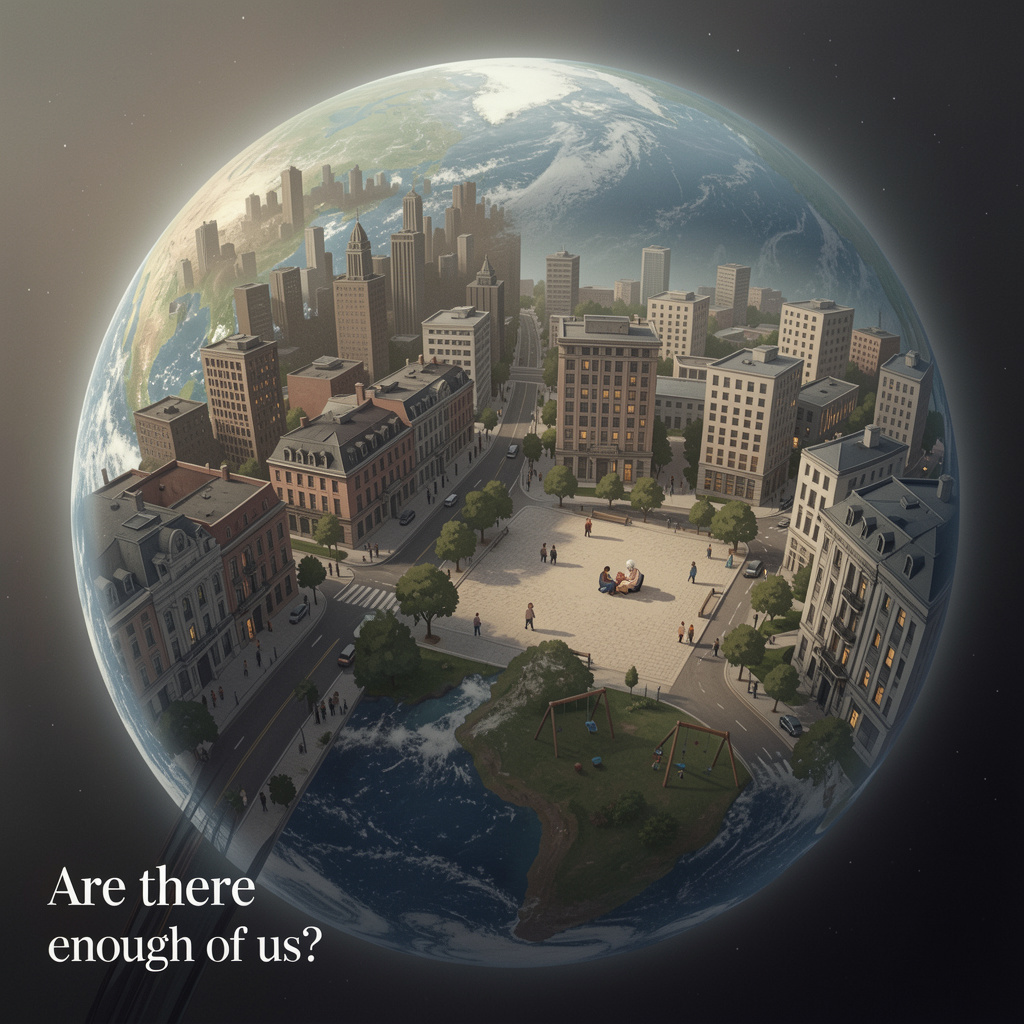
In contrast to these creative aspects towards end of our days, statistics show a much standard path that we are already on as we speak – the matter of population growth, or at this point, decline. It’s so funny cause when we were kids, I remember the news screaming with fear that “there is just too many of us”.
Too many mouths to feed. Too many people competing for land, water, jobs and energy. Too many humans for a planet with finite resources.
The fear became so familiar that it almost turned into common sense. The world population was exploding, and surely that could only end badly.
But somewhere along the way, the demographic story changed. We are still getting more crowded in some places, but globally, the conversation has quietly moved from “How do we stop population growth?” to “Wait… why aren’t people having children anymore?”
The population isn’t actually disappearing — yet
First, a correction to the headline. (I told you we were lenient to drama!)
The world is not suddenly becoming empty. There are currently more than 8 billion people on Earth, and the United Nations still expects the global population to grow for several more decades, reaching roughly 10.3 billion around the mid-2080s before beginning a gradual decline.
But something important has changed underneath that number.
People are having fewer children. (That is the core reason why governments are freaking out. Surely it scares politicians to have less tax-payers and more elderly to take care of each decade.)
The global fertility rate has fallen dramatically over the past several decades. Across OECD countries, the average fell from 3.3 children per woman in 1960 to around 1.5 in 2022 — far below the roughly 2.1 needed for population replacement.
So… what happened?
The obvious answer would be: people simply decided they don’t like children anymore. – It is also the least interesting answer.
The reality is that having children has become a very different decision.
For previous generations, adulthood often followed a relatively predictable sequence: education, work, marriage, children. Today, that sequence has become longer, more expensive and much less automatic.
People spend more time in education. They enter the labour market later. They move away from home later. They marry later, if they marry at all. They spend longer establishing themselves financially.
And by the time someone feels ready to have a child, they may already be in their middle ages.
Women changed the equation
There is another enormous piece of the puzzle: Women gained more control over whether, when and with whom they have children.
Access to contraception, higher levels of education and dramatically increased participation in the labour market fundamentally changed the economics of family formation.
And this is important because having children used to be less of a choice.
Now it is one.
That doesn’t mean women simply “chose careers over babies.”
It means women gained something previous generations had much less of: the ability to choose.
And once parenthood becomes a choice rather than an inevitability, people start asking whether they actually want it.
Some do.
Some want one child instead of three.
Some want children later.
Some want children but cannot afford the life they imagine for them.
And some simply don’t want children at all.
That last group is becoming increasingly socially acceptable.
And now governments are worried
This is where the population conversation gets almost comical.
For decades, governments worried about population explosions. Now some of those same governments are offering tax breaks, childcare subsidies, parental leave and other incentives to persuade people to have more babies.
Because fewer babies today means fewer workers tomorrow. And fewer workers supporting more retirees.
Low fertility combined with increasing life expectancy creates an ageing population, which puts pressure on pensions, healthcare and social protection systems.
Suddenly demographics become economic, then inevitably become political. On the news they say they are worried about culture, family, values being transferred through generations and surviving as a nation. The truth is there is only one question in their minds:
Who pays for everything when there aren’t enough young people?
So after all that’s said and done, this hyper-focus on birth rates may ultimately be about something much simpler: being scared to be lonely.
Having someone to take care of us. Someone to keep the system going. Someone to make sure we survive when the “dark days” eventually come.
But maybe it doesn’t have to be like that.
Women were among the first to show that a life lived alone does not necessarily mean a life lived in loneliness. You can find other resources. Build your own ways of sustaining yourself. Surround yourself with people who become family in different ways.
It simply requires a different approach to life.
And perhaps we are slowly developing the tools to do exactly that. Advancements in medicine prolong our life expectancy. Psychology increases our awareness of ourselves and our experiences. Technology changes how we connect, work and care for one another.
Maybe the next stage of humanity does not have to be about becoming more numerous.
Maybe it can be about becoming better at existing.
After all, we spent centuries designing our societies around the assumption that there would always be more of us.
Perhaps now we need to learn how to design them around the possibility that there won’t be.
Perhaps the real question is not how many of us there will be, but whether our world and its systems are ready for a new era of humanity.
With love,
Zey
Leave a Reply